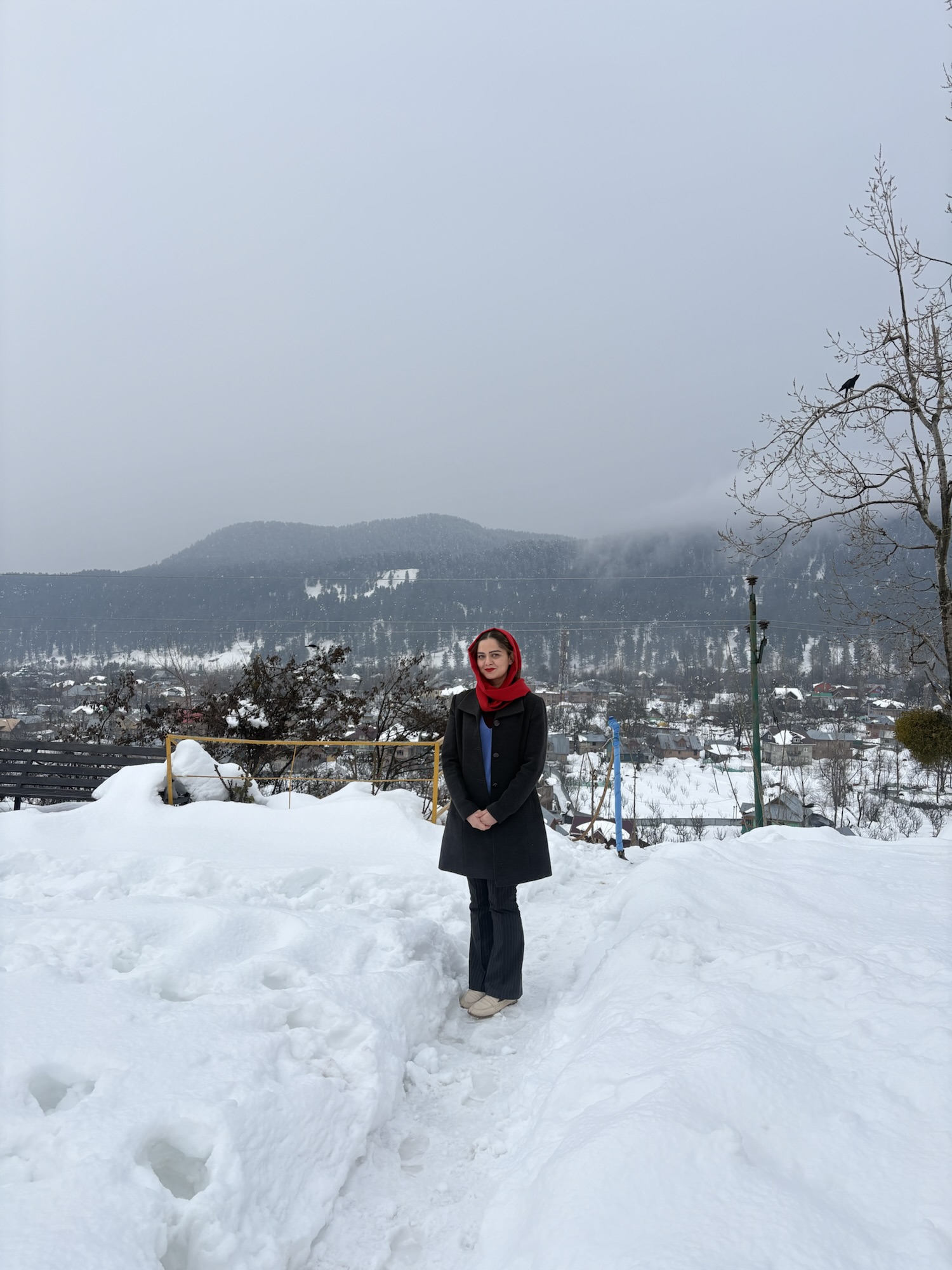
Snow arrives without spectacle, yet it completely reorganizes perception. Forests once known by edges, barks, branches softens into continuity. Depth flattens, color withdraws, and what remains is a world reduced to form and rhythm. This reduction is not merely aesthetic. It alters how attention moves, and, in doing so, reshapes the conditions under which thought occurs.

Human responses to snowy landscapes have long suggested that something cognitive is at work. Winter scenes in painting and literature are rarely celebratory. They are contemplative, often spare, concerned less with abundance than with suspension. Snow, unlike other natural phenomena, does not announce growth or decay. It signifies pause, a temporary arrest that allows underlying processes to continue unseen.
Ecologically, snow functions as insulation rather than erasure. Beneath its cover, forests remain active, roots exchange nutrients, and microorganisms persist, seeds wait. Snow moderates temperature, preserves moisture, and protects fragile systems from exposure. What appears inert is, in fact, a form of quiet maintenance.
The creative mind seems attuned to this logic. Contemporary culture encourages creativity as output i.e., visible, continuous, and responsive. Ideas expected to appear fully formed, articulated at speed, and circulated immediately. Under such conditions, creativity becomes performative rather than exploratory driven by urgency rather than depth.
Snow-covered forests offer a counter-model. They suggest that productivity need not be constant to be meaningful, and that restraint can be generative. In such environments, the demand to interpret, evaluate, and respond diminishes. Attention loosens its grip. Thought becomes less directive, more associative.
Stephen and Rachel Kaplan’s Attention Restoration Theoryproposes that natural environments replenish depleted cognitive resources by reducing the burden on directed attention. Landscapes that are softly fascinating engaging without demanding effort allow the mind to recover its capacity for reflection. Snow amplifies this effect. With color muted and contrast softened, the mind is relieved of the work of constant discrimination. What remains is mental spaciousness, a condition in which reflection becomes possible.
This may explain why snowy landscapes so often accompany moments of insight in philosophical and literary traditions. They do not instruct the observer; they withdraw. Meaning is invited not imposed. The forest, stripped of excess detail, becomes a surface onto which thought can project itself without resistance.
For artists and writers, such spaces create a rare permission, the legitimacy of slowness. Ideas surface not through pursuit but through availability. Like biological processes occurring beneath snow, creative work continues indirectly, strengthened by delay rather than weakened by it.
There is also an ethical dimension to snow’s aesthetic. Snow covers without preference. Paths, fallen branches, animal tracks, and human interventions are rendered equally provisional. In this levelling, hierarchies recede. The forest is no longer organized around utility or dominance but around coexistence and duration.
This quiet egalitarianism mirrors a deeper creative truth. Inspiration is not the privilege of exceptional moments. It emerges through sustained attention, repetition, and tolerance for uncertainty. Snow teaches that withholding can be as formative as expression.
In an era, that equates renewal with novelty, snow-covered forests demonstrate the power of subtraction. The landscape does not change its substance; it changes its legibility. What was always present becomes newly perceptible through concealment.
When snow melts, it leaves behind more than water. It reshapes soil chemistry, regulates future growth, and ensures continuity across seasons. Time spent within such landscapes operates similarly on the mind. The effects are not immediately visible, nor easily measured, but they persist as recalibrated attention, renewed patience, and a restored capacity to think without demand.
The beauty of snow-covered forests lies not in their stillness alone, but in what they model a rhythm of retreat and return. They remind us that creativity, like ecological systems, depends not on constant emergence, but on cycles of suspension and that, rest, far from being the absence of work, may be its generative condition.

Leave a Reply