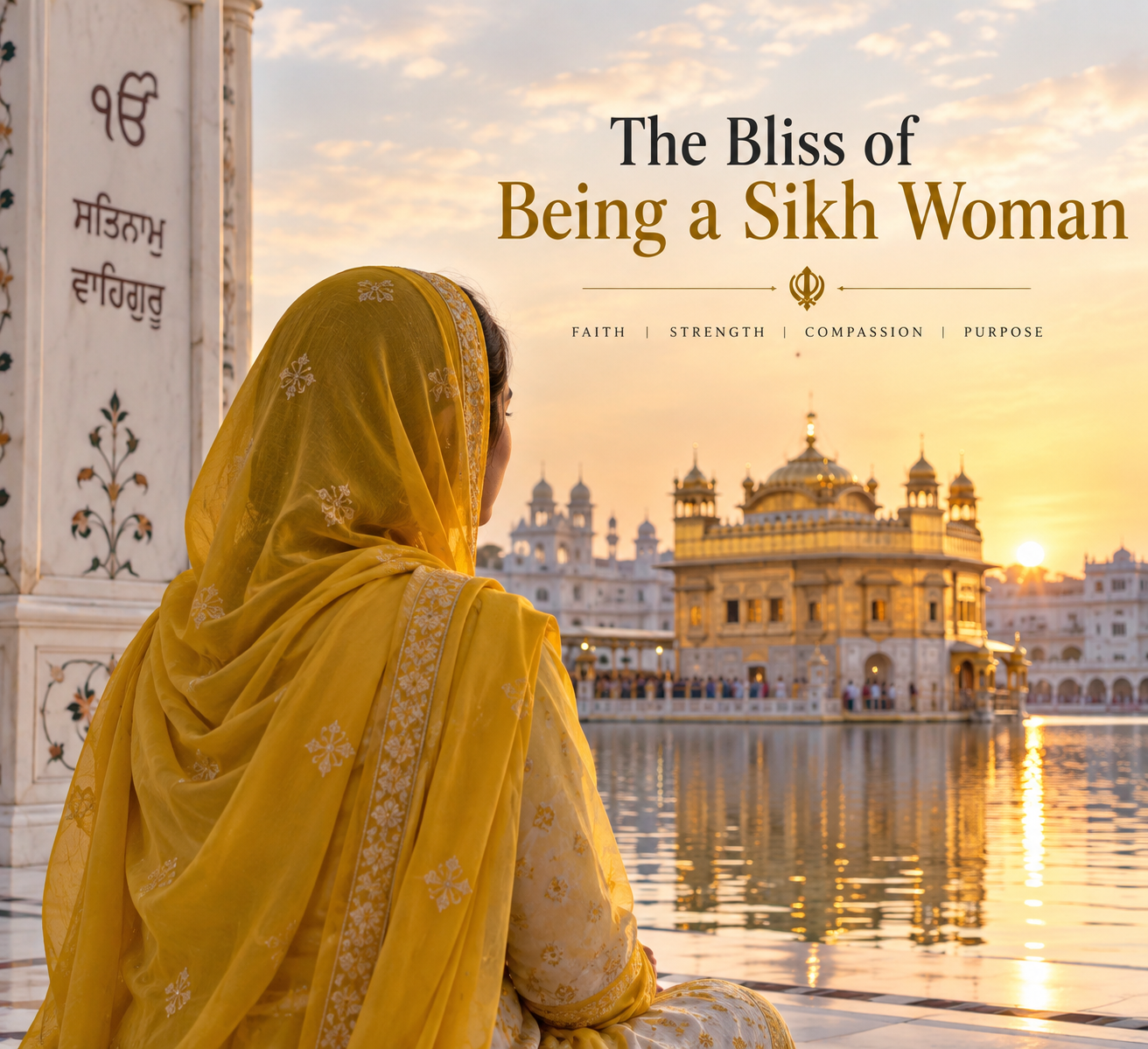
I take immense pride and quiet joy in being a Sikh woman. Belonging to a faith that looked at my gender centuries ago and said, “You are equal, you are whole, you are welcome.” This is the kind of bliss that runs through the life of a Sikh woman. It is neither borrowed happiness nor privilege slowly negotiated over generations but a birthright written in the very foundation of Sikhism. In order to understand this bliss, one has to walk through many rooms of a Sikh woman’s life: her spiritual inheritance, her historical lineage, her place in the community, her identity, and her everyday acts of service and devotion.
Guru Nanak Dev Ji, the founder of Sikhism, lived in a society where women were treated as lesser beings, denied education, and blamed for original sin in many existing traditions and often excluded from spiritual leadership. But he questioned that rudimentary thought process and asked why women should be called inferior if they give birth to kings. This statement was not just a poetic quote but rather became a doctrine. All Sikh Gurus reinforced this in both word and practice later. Women were permitted to lead prayers, read scriptures, sing hymns of praise, manage gurdwaras, and even take up arms in defense of the community. There is no priesthood in Sikhism that a woman is barred from or any ritual reserved just for men.
ਸੋ ਕਿਉ ਮੰਦਾ ਆਖੀਐ ਜਿਤੁ ਜੰਮਹਿ ਰਾਜਾਨੁ ॥
“Why call her inferior, from whom kings are born?”
Even Sri Guru Granth Sahib Ji, the eternal and living Guru of the Sikhs, uses feminine imagery for the soul’s longing for the divine and does not draw a line between the spiritual worth of a man and a woman. This is my first source of absolute bliss: the sheer relief of a theology that does not require a woman to apologize just for existing or to prove her worth through circumstances of life or to access God through the mediation of a man.
A Sikh woman can enter a gurdwara, bow before the Holy Lord, and know that in that moment, she stands exactly where any man stands: equal before the Guru.
Sikh history is populated with women whose courage reads like legend, and it belongs to every Sikh woman as a part of theinheritance.
Mai Bhago (Mata Bhag Kaur), dressed in men’s armor, valiantly led 40 Sikh warriors against the Mughals in the famous Battle of Mukatsar in 1705, becoming the first woman in the history of Punjab to fight on a battlefield. Although injured, she was the sole survivor in the battle. Mata Gujri, the mother of Guru Gobind Singh Ji, stood as a pillar of great strength through unimaginable loss, including the martyrdom of her grandsons.Bibi Dalair Kaur commanded armies. Guru Gobind Singh Ji entrusted the defense of Anandpur Fort to young Dalair Kaur, who commanded 100 Khalsa women and 10 Khalsa men. Her courage represents the warrior spirit of endurance, faith, and resistance under unbearable circumstances. Countless unnamed women endured the eighteenth-century persecutions with a steadiness that shaped Sikh identity itself, refusing to renounce their faith even as their children were threatened before their eyes.
In today’s world, to be a Sikh woman is to fully feel the pulse of that courageous lineage. It is the lineage of the Kaur, a name given to every Sikh woman that means “princess.” A Kaur is sovereign. She does not need to take her father’s or husband’s surname in the way many traditions require because her identity was never meant to be borrowed from a man. The identity is her own, a self-standing, dignified woman, and I feel that every day.
If Mai Bhago represents the Sikh woman’s courage with the sword, Mata Khivi represents her power through seva, equality, and community. Mata Khivi Ji married Guru Angad Dev Ji, and she recognized the spiritual wisdom of her husband and offered full support in his mission to spread the message of Sikhism and its values. Their marriage was not a union of two people but a partnership, and one of her most important contributions was her role in the langar, or community kitchen system, established by Guru Angad Dev Ji. She remains an admired figure in Sikhism.She has also been mentioned in the holy scripture.
Sri Guru Granth Sahib Ji, Ang 967:
ਬਲਵੰਡ ਖੀਵੀ ਨੇਕ ਜਨ ਜਿਸੁ ਬਹੁ ਤੀ ਛਾਉ ਪਤ ਲੀ ॥
“Khivi is a noble person, beneath whose shade there is abundant shelter.”
Also beyond the history, the bliss of Sikh womanhood lives in the ordinary too. It resides in the langar hall, where she rolls rotis alongside family and strangers without distinction of caste or class. It lives in the kirtan when her voice joins the devotional singing, dissolving the boundary between self and sangat(community). There is bliss in raising children within a tradition that teaches them that devotion is not practiced in the margins. A Sikh woman does not have to fight to be remembered in prayers; her children learn because Ardas, the daily Sikh prayer itself, recalls the sacrifices of both Sikh men and women in the same breath.
There is bliss in not having to hide also. A Sikh woman who wears her faith openly with kesh (uncut hair), kada on her wrist, and a steady gaze does not need to shrink, soften, or curate herself for approval. She is taught that her body is not something to be ashamed of or something that needs approval of others; it is a vessel of the divine worthy of the same dignity, modesty, and pride granted to any man.
But this bliss also coexists with struggle, like other women in the world carefully treading the patriarchal cultural practices, sitting alongside faith’s egalitarian teachings. Everything is definitely not perfect, but every Sikh woman who reads Sri Guru Granth Sahib, who leads kirtan, and who commands respect or names her daughter ‘Kaur’ with pride is actively renewing the promise made centuries ago.
And the most blissful side of this entire architecture is that to be a Sikh woman is to carry both sword and hymn, both scripture and langar spoon. It is a bliss rooted in dignity, courage, equality, and a quiet comforting and unshakeable knowing that she was never an afterthought in her faith but always from the very beginning its equal heart.
Published article link: https://sikhnet.com/news/bliss-being-sikh-woman
