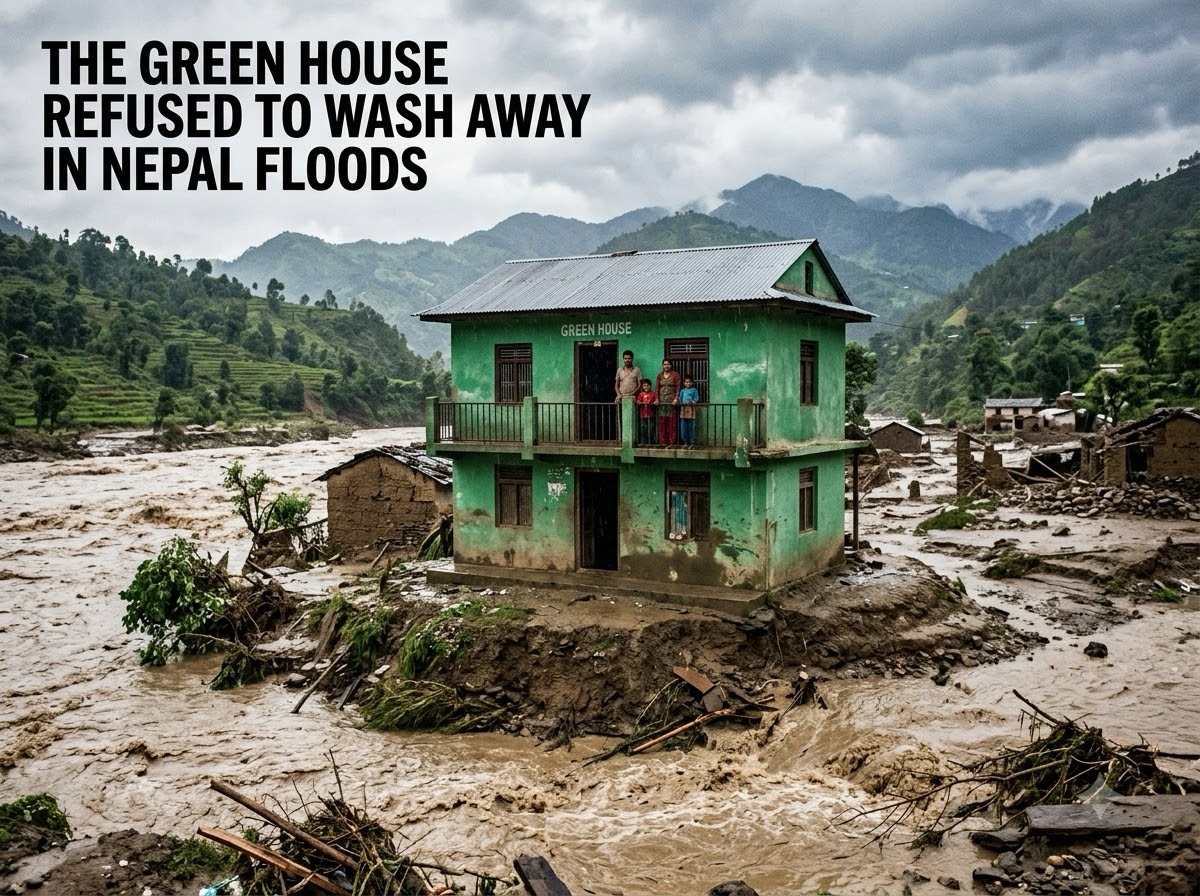
On 26th August, 2026, catastrophic flash floods tore through Nepal-Tibet border region due to glacial lake outburst that led to debris and water crashing down Bhote koshi and Trishuli river basins. Around 780 people have lost their lives and over a thousand are missing including foreign tourists from India, Australia, Britain,Canada and the United States. Entire villages in districts like Rasuwa, Nuwakot, Dhading and Chitwan were swallowed by the surge including highways and bridges. But among this destruction, one image of a light green three storey house emerged that the world could not look away from. The house stood untouched in the middle of the raging floodwaters while everything around it was torn from the earth.
A lone standing house caught in the torrent was captured on phones and shared widely on the internet. It was an absolute disaster to see family members standing on the balcony and watching floods tear past just feet below them carrying trees, debris and remains of nearby buildings. For a few agonising minutes, viewers from across the world watched that viral video with dread and utter disbelief unsure whether the structure or people inside would survive the night.
But against all odds that seemed almost impossible, the green house held its ground while the entire neighbourhood swept away. When rescue teams eventually reached the area, the family was found alive and then rescued since the videos of their ordeal had already gone viral fetching millions of views and online commentary at what seemed nothing short of a miracle.
For a catastrophic disaster as big as this, the sight of one house and one family spared in the middle of chaos personally felt like a sign of something larger than engineering was at work.
A flurry of comments and viewpoints appeared on the viral video suggesting exemplary work done by builders or engineers in laying the foundation of the house.
Whether attributed to faith or construction, the sentiment was resonating that it was “the hand of God” indeed. As I see it, perhaps the truest power of this story lies in both the explanations at once but for the family standing on the balcony watching the chaos at play, prayers andphysics were working in tandem. Many disaster analysts and structural engineers put forth their explanations suggesting the building’s column and foundation played a critical role as deep set pillars are believed to have redirected the force of floodwater around the base rather than absorbing its full impact. It was also pointed out that maybe the house’s position was slightly elevated and angled from the flow of the main channel that spared it the most direct battering. But none of this can diminish the emotional weight of what people saw. As I see it, construction and extraordinary luck are not mutually exclusive.
In these past few days of grief as the Nepal army and volunteer teams continue rescue operations with the death toll climbing every passing day, the image of the green house became something larger than a single family’s survival. It became a symbol of hope, resilience and faith rewarded in the middle of overwhelming loss.
For a nation that has weathered glacial floods, earthquakes and monsoon disasters before, the story of the green house offered something rare in the aftermath of a tragedy, a moment we all can hold onto. It did not undo the loss experienced by the families but it has surely given a reason to believe that even amid catastrophe, providence and survival can find a way through.
Now whether we call it engineering, divine intervention or luck, the green house of the Nepal floods has earned its place in how this disaster will be remembered. It stands as a proof that even when nature moves with full determination and force, we are never entirely abandoned. I feel that the standing foundation carries a profound promise amidst the chaos, an unseen hand always retains the final word in any catastrophe of life, offering a beacon of hope and subtle reminder that grace will always anchor us through the storm.
