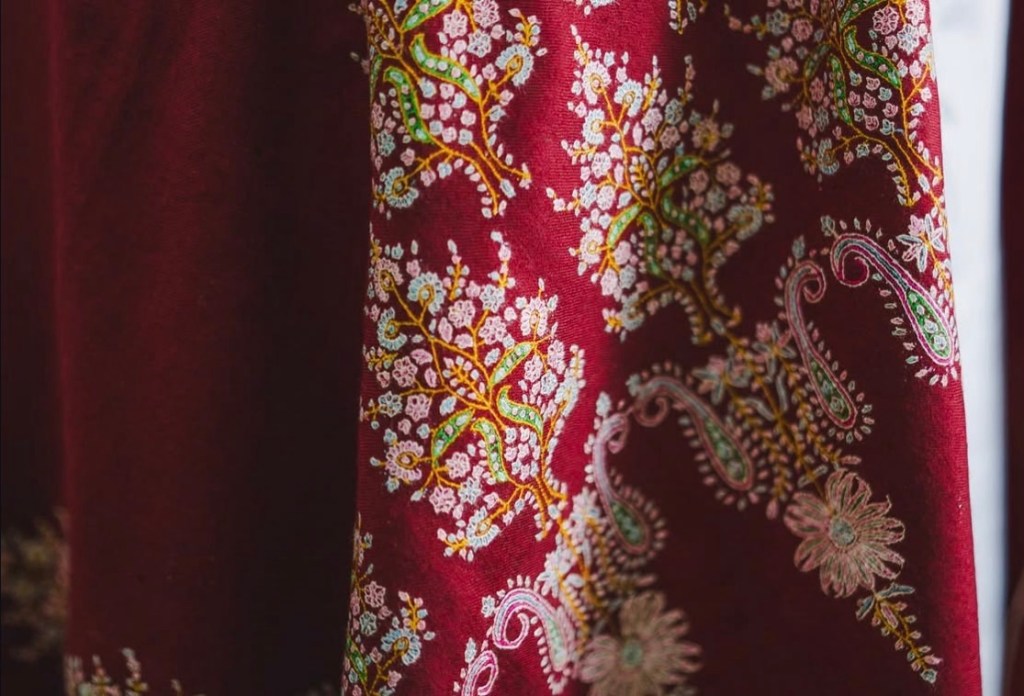
Winter is coming! And so has my unadulterated love for Sozni shawls exquisitely embroidered by karigars who have nurtured this artwork over the years. What absolutely catches my heartbeat is the quiet disciplined world of a craftsman where he measures his love in threads to keep this profound artwork alive and thriving. Whenever I get a chance to wander through the Bund area of Srinagar, I cannot help myself but gaze at the old-world charm stretched across the riverside tucked behind old brick buildings with karigars weaving stories with their skilful hands. A rhythm made not out of machines but patience-the sound of a needle slipping through soft pashmina, the gentle sigh of silk thread being pulled taut.
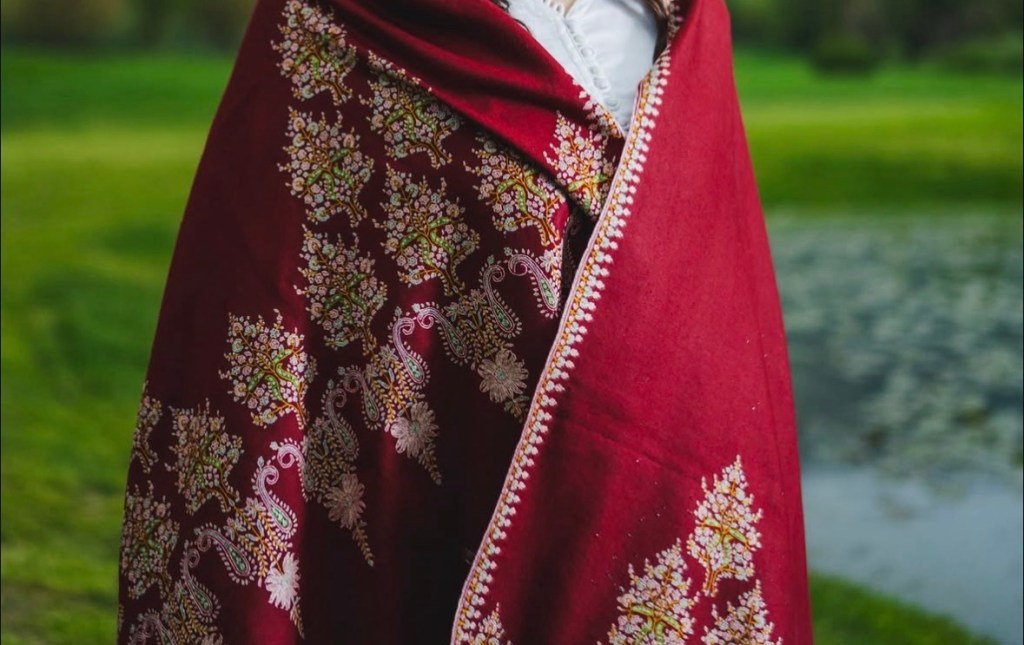
A Stitch Through History
Etymologically, the word “Sozni” has been derived from the Persian word “suzan” meaning “needle”. Historically, this exquisite tradition of Sozni embroidery, arrived in Kashmir as early as 14th century under the reign of Sultan Zain-ul-Abidin, also known as Budshah. Over the years, the art adopted valley’s grace and charm. The wonderful beauty of Kashmiri Sozni embroidery thrived for generations, incorporating inspirations from many historical periods, rulers, and cultural exchanges.
Kashmir saw a cultural revival in the 15th century under the Mughal Empire. This enhanced Sozni embroidery even more. The arts were supported by the Mughal kings, especially Akbar. As a result, their impact greatly influenced how different crafts developed in the area.
Later with the advent of Sikh rule in Kashmir in the 19th century, Sozni embroidery flourished even more during Maharaja Ranbir Singh’s rule. As a result of the Maharaja’s strong desire to support Kashmiri arts, ateliers and workshops devoted to the skill were established. Its continuance was further guaranteed by this.
But in 2021, the Kashmiri Sozni shawl received a great feat by getting the Geographical Indication (GI) tag, a long-awaited recognition that ties authenticity to origin. It ensures that the name Kashmiri Sozni belongs only to the hands of those who have kept it alive for generations — many of whom sit right here along the Bund.
The Art of Patience
Watching a Sozni shawl being made is like witnessing a poetry in motion as the artisan takes each motif on a journey of its own by beginning with a faint outline later embroidered using fine silk threads, often in double-sided technique so perfect that neither side looks wrong. The hypnotic rhythm that still stands strong like meditation in the age of digital speed demands immense focus. Even a small pattern may take weeks, a full shawl, nearly a year.
If you walk along the Bund on a crisp autumn morning,you’ll find this legacy alive. Inside modest wooden workshops with low ceilings and fading posters, Sozniartisans work under the yellow glow of bulbs, their eyes adjusted to precision. Many start before sunrise, breaking only for tea.
I often stop by one such workshop owned by Gulzar Sahab, third-generation Sozni artists. The air there smells faintly of wool, damp wood, and kehwa. Their hands move instinctively, the elder tracing delicate motifs, the younger threading new needles.
“We grew up with this,” Zahid says, smiling. “Our father used to say, “Zindagi taan yiman dagh manzhewan chu: life lives in these threads.”
They earn little for their mastery. A shawl that takes eight months of hand embroidery may fetch them barely a fraction of its market price. Yet there is pride, quiet and unspoken, in the precision of every stitch. These are men and women who refuse to let haste erase heritage.
Sometimes, when I get a chance to witness these magical moments with them, they tell me of the world outside of changing tastes, of machine embroidery flooding markets, of sons who choose office jobs over looms. Yet as their hands continue their delicate dance, I see resilience glowing like the soft Jhelum light filtering through the window.
So, my deep affection for Sozni is not merely aesthetic: it’s emotional. Every handmade piece I own carries a story: of the karigar who embroidered it by lamplight, of winters spent in stillness, of devotion disguised as labour. I often say I don’t buy shawls; I adopt them. Each one holds a fragment of a craftsman’s soul, a whisper of his patience. When I drape one around my shoulders, I feel wrapped not just in wool but in warmth — of history, of human touch, of unbroken continuity.
The artisans remind me that beauty is not born in haste. It takes time, like love, to perfect itself — stitch by stitch, shade by shade.
Last winter, as I stood on the Bund bridge one evening watching the river glitter in the fading light. A gentle snowfall had started. In my bag,I had a newly purchased Sozni shawl, maroon with green vines twisting like poetry. I considered the hands who created it, the many hours of silent labor behind each bloom and leaf.
Holding it close, I could almost hear the karigars’ whisper: “Beauty takes time, So does love.”
And I knew that if there are hands like theirs, patient and proud, Kashmir will continue to create poetry from thread.

 HARDEEP BALI
Leave a comment