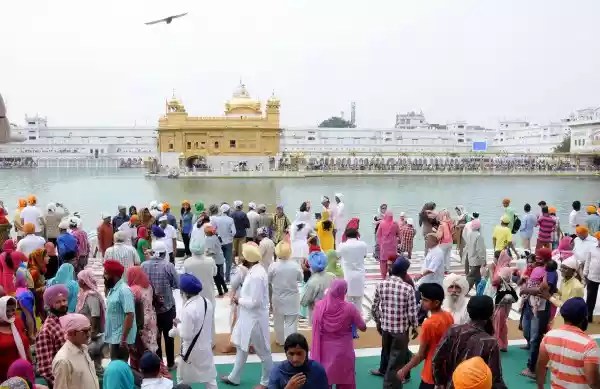
Baisakhi”, Khalsa Panth Saajna Diwas
Baisakhi, Sikh New Year festival is considered as one of the most important dates in the Sikh calendar. It is celebrated every year either on 13th or 14th April to commemorate the birth of Sikhism, a religion of collective faith.
History
In 1699, the tenth guru of Sikhs, Sri Guru Gobind Singh Ji chose this day to create a new nation, often termed as “Panth” with the intent to transform Sikhs into brave soldiers so that they can face hurdles courageously. During the Vaisakhi festival in the year of 1699, Sri Guru Gobind Singh Ji challenged Sikhs to come forward and give their life for the creation of Khalsa Panth. Five people volunteered for the cause after which the gathering noticed blood on Guru Ji’s sword as those men kept on disappearing into the tent but in the end, everyone was surprised to see five turban clad men coming out of the tent with Guru ji. That is how; the Khalsa Panth was founded in front of scores of people at Anandpur Sahib. Later on, those five men were called Panj Piare, or the ‘Beloved Five’.
Basically, on that day, those five men were baptised into Khalsa by Sri Guru Gobind Singh Ji by sprinkling holy water or “Amrit” and by praying.
Khande-di-Pahul
The Sikh baptism ceremony is termed as “Amrit Sanchar” and the person who has been initiated into Khalsa is termed as “Amritdhari” or “Khalsa”. The motive is to encourage Sikhs to dedicate themselves to the Holy Lord and thus establishing a connection with the God for the right guidance.
Max Arthur Macauliffe, a prominent writer of the 20th century perfectly describes baptism ceremony as,
“The Guru caused his five faithful Sikhs to stand up. He put pure water into an iron vessel and stirred it with a Khanda or two edged sword. He then repeated over it the sacred verses which he appointed for the ceremony, namely, the Japji Sahib, the Jaap Sahib, Guru Amar Das’s Anand Sahib, and certain swaiyas or quatrains of his own composition.”
At the end of the baptism ceremony, every person repeats the salutation “Waheguru Ji Ka Khalsa, Waheguru Ji Ki Fateh” after which the holy water is sprinkled on the eyes and hair around five times. Further, the remainder of the nectar is shared by all receiving the initiation and everyone drinks “Amrit” from the same bowl.
After baptism, every Sikh is supposed to wear five articles of Faith i.e., Kesh (unshorn hair), strapped Kirpan (sword), Kachhehra (prescribed shorts), Kanga (comb tucked in the tied-up hair), Karha (steel bracelet).
Celebrations
On Baisakhi, colourful processions known as Nagar Kirtans take place around the world and Gurdwaras host celebrations during the weeks of Vaisakhi, where readings of Sikh scriptures take place and hymns from the Sri Guru Granth Sahib, the Sikh holy book are sung. The major celebration on Baisakhi takes place at Anandpur Sahib, Amritsar.
Significance of Baisakhi
The Khalsa Panth was created with the intention to bring equality in mankind. There is no room for racism or discrimination in Sikhism. Thus, Baisakhi is a glaring reminder of the freedom of spiritual practice i.e., a political system has to be righteous. Hence, it can be said that without fear of the God righteousness may not prevail.
Sikh way of life ensures community cohesion, inclusiveness, respect and dignity for all the races of the world irrespective of creed, race, colour, religion, nationality or language.

 HARDEEP BALI
Leave a comment